

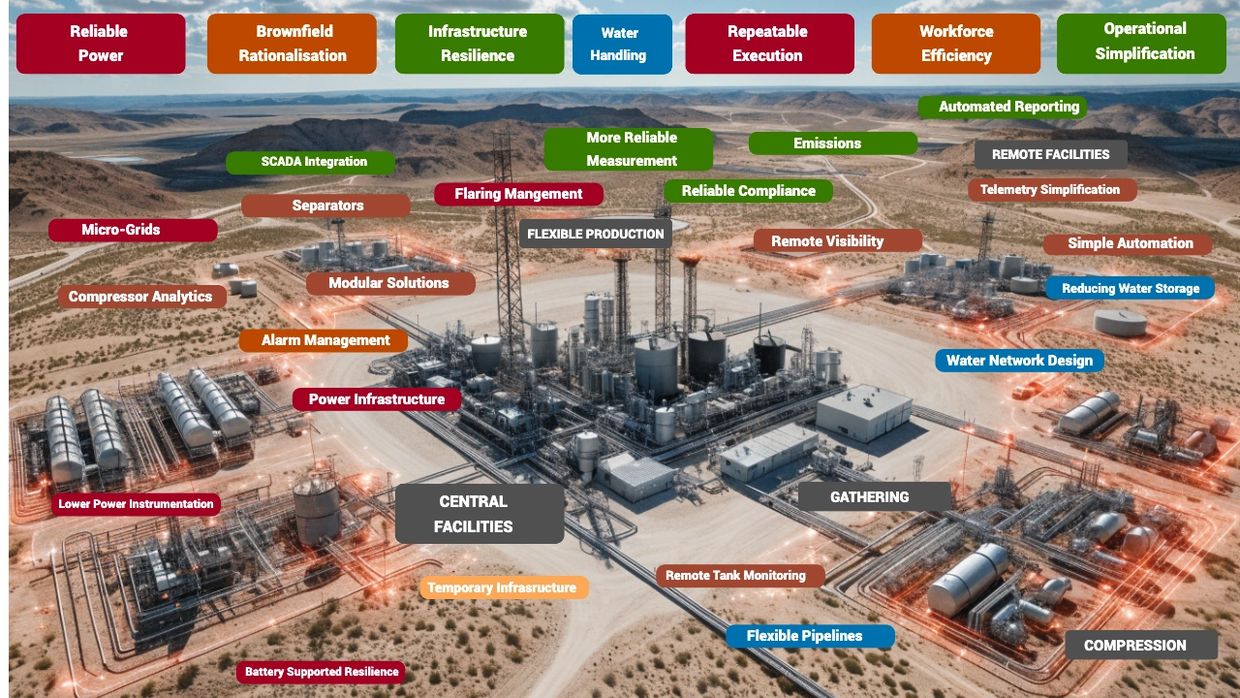
Opportunities To Participate Through Strategic Collaboration Or Solution Showcasing
The feedback we’ve had from upstream operators this year makes one thing very clear: the vendors that are gaining traction are those with proven operational track records, verified performance in live field environments, and a clear understanding of the realities E&Ps are managing every day.
Operators are increasingly prioritising partners who understand operational pressure, workforce strain, uptime risk, and execution simplicity. The strongest engagement will be from vendors that can demonstrate how they reduce operational burden, simplify execution, and improve day-to-day reliability without introducing additional complexity.
Reducing Engineering Complexity Is Becoming A Strategic Priority
Facilities leaders continue to place major emphasis on modularity, but the conversation has evolved. The focus is no longer simply on speed of deployment. It is increasingly about lowering engineering complexity, simplifying maintenance, reducing field execution risk, and creating repeatable infrastructure models that can scale more efficiently across portfolios.
Many operators are now trying to transition temporary infrastructure, rental equipment, and fragmented legacy assets into more rationalised and permanent operating models.
That means selective modularity is becoming strategically important — particularly where it helps replace ageing systems, streamline operations, reduce maintenance intensity, and standardise execution across brownfield environments.
Selective Automation Is Winning — Over-Engineered Systems Are Not
Across operators of all sizes, there is a noticeable shift away from overly layered automation strategies toward more targeted and operationally focused deployment.
The strongest interest is centred around automation solutions that deliver measurable operational outcomes: reduced alarm fatigue, improved remote visibility, lower field staffing requirements, faster issue identification, and proven ROI.
Operators are looking for automation that reduces friction inside the operating environment and improves execution quality with leaner teams.
That places practical operational value — rather than technological sophistication alone — at the centre of 2026–2027 investment priorities.
Power Stability Has Moved To The Centre Of Facilities Strategy
Perhaps the single biggest strategic issue continuing to dominate operator thinking is power reliability and long-term infrastructure resilience.
The conversation around electrification has changed significantly over the last three years. It is no longer primarily framed around sustainability positioning or emissions messaging alone.
Operators are now approaching electrification through a much harder operational and commercial lens.
The questions being asked are increasingly practical:
- How do we improve backup resilience?
- How do we reduce generator dependency?
- How do we stabilise field power with lower operational exposure?
- How do we lower maintenance intensity across distributed infrastructure?
- How do we support growth without continually expanding temporary power solutions?
As a result, permanent electrification strategies, backup systems, low-maintenance power infrastructure, microgrids, and integrated power management systems are becoming central components of long-term facilities planning.
Brownfield Rationalisation Is Also Becoming One Of The Defining Themes Of 2026
Across entire portfolios, facilities operators are under growing pressure to simplify brownfield complexity while simultaneously improving efficiency, reliability, and capital discipline.
That is driving increasing focus on:
- standardised facility designs
- infrastructure consolidation
- replacement of scattered temporary systems
- simplification of duplicated operational layers
- reduction of stranded or underutilised infrastructure
Operators are increasingly looking for technologies and infrastructure strategies that help consolidate electrical systems, integrate backup redundancy more effectively, simplify controls, and reduce operational fragmentation across field sites.
This includes interest in gas-to-power systems, modular electrical infrastructure, microgrid controls, backup resilience technologies, and integrated power management solutions that support more streamlined operating models.
Operational Visibility Is Becoming More Important As Teams Get Leaner
Many brownfield environments continue to suffer from fragmented controls, disconnected alarms, duplicated monitoring systems, and inconsistent operational visibility across sites.
At the same time, workforce structures are becoming leaner — meaning operators have less tolerance for blind spots, delayed response times, or unnecessary operational noise.
As a result, there is growing strategic interest in solutions that improve:
- alarm rationalisation
- operational interoperability
- integrated visibility
- remote monitoring
- predictive maintenance visibility
- low-maintenance telemetry infrastructure
Operators increasingly want operational clarity rather than overwhelming volumes of disconnected digital information. The value is no longer in generating more data. The value is in improving decision-making quality and execution speed across leaner operating environments.
Water Infrastructure Efficiency Is Becoming A Facilities-Level Conversation
Although water management may not always sit at the centre of facilities conferences, facilities leaders increasingly view water infrastructure optimisation as a core operational efficiency issue.
The focus is not simply environmental. It is operational and economic.
Operators are trying to reduce duplicated routing systems, minimise excessive trucking exposure, improve disposal efficiency, and eliminate underutilised infrastructure wherever possible. That is creating stronger interest in:
- water network redesign
- routing optimisation
- disposal optimisation
- modular treatment systems
- flexible pipeline systems
- transfer pump infrastructure
- monitoring and automation technologies
The broader objective is to simplify infrastructure networks while reducing operating cost exposure and improving long-term field efficiency.
The Strongest Vendor Interest Is Centred Around Simplification, Not Expansion
Taken together, the strongest areas of operator interest heading into 2026 and beyond are increasingly centred around simplification, reliability, interoperability, resilience, and operational efficiency.
The technologies gaining attention are not necessarily the most complex. In many cases, they are the solutions that help operators reduce operational burden, rationalise brownfield complexity, stabilise infrastructure performance, improve workforce efficiency, and support leaner long-term operating models.
Ultimately, operators are looking for partners that help engineer clarity, resilience, and operational control into increasingly constrained and cost-sensitive environments.