Over the last several weeks we conducted more than 40 in-depth research conversations with upstream operators — large, medium, and small — across the Permian Basin, Eagle Ford, and other onshore oil-producing regions across North America.
Irrespective of operator size, the same operational pressures and trade-offs surfaced repeatedly:
- Power reliability
- Gas and water takeaway constraints
- Inherited brownfield complexity
- Infrastructure fragmentation
- Contractor execution quality
- Lean workforce structures
- Electrification uncertainty
- Growing pressure to simplify operations without losing future flexibility
Many operators are now managing facilities infrastructure shaped by acquisitions, temporary workarounds, shifting production priorities, and years of incremental modifications layered on top of one another.
At the same time, facilities teams are under increasing pressure to:
- improve reliability and efficiency
- reduce operational complexity
- lower operating cost
- modernise infrastructure
- maintain production flexibility
- and execute faster with leaner organisations
…all whilst operating under tighter capital discipline and greater pressure to deliver predictable operational performance.
More or less every operator we spoke to ultimately came back to the same core challenge:
How do you execute more effectively under tighter operational and financial conditions — without creating new infrastructure, reliability, or workforce risks elsewhere in the system?
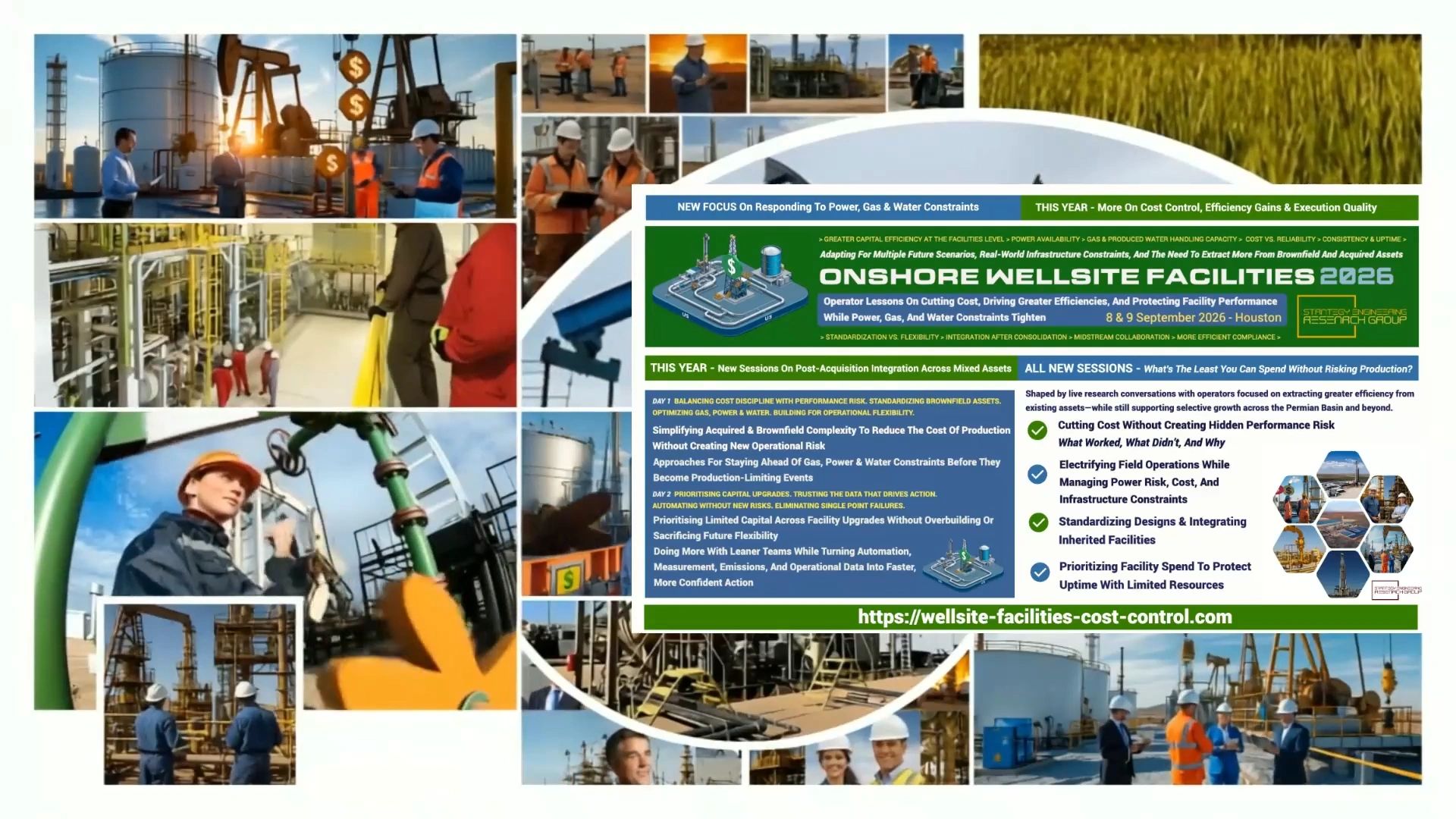
That question now sits at the centre of facilities strategy across North America — forming the lens through which this year’s agenda explores key issues such as power reliability, execution quality, infrastructure simplification, brownfield optimisation, electrification ROI, and operational flexibility.
Reliable Power Remains A Major Strategic Facilities Issue In 2026 - What Are The Latest Approaches For Different Situations? And What Does ROI Look Like On The Earlier Investment Decisions?
As operators increase reliance on electrified systems and grid-connected infrastructure, power availability itself is increasingly becoming a constraint — particularly as production systems become more interconnected and operational downtime becomes less tolerable.
At the same time, many operators are now entering the phase where they can finally evaluate whether electrification strategies initiated several years ago are genuinely delivering the operational and financial returns originally expected.
Operators are increasingly asking:
- Did reliability improve as planned?
- Were operating costs actually reduced?
- Did complexity simply move elsewhere in the system?
- And how should electrification strategies evolve moving forward?
To address this, multiple sessions throughout the conference focus on:
- real-world power reliability lessons
- electrification ROI
- unstable grid conditions
- rental generation dependence
- brownfield electrical constraints
- field execution challenges
- and long-term infrastructure flexibility
Portfolio Optimisation Is Becoming Just As Important As Individual Asset Performance
One of the clearest conclusions from the research process was that facility performance is once again becoming central to profitability, operational predictability, and future competitiveness.
Facilities strategy can no longer be separated into either expansion or rationalisation. In many cases, operators are now having to pursue both at the same time across different parts of the asset base.
The case studies will help you determine how to adapt or upgrade facilities systems that are:
- efficient without becoming rigid
- simplified without losing visibility
- scalable without becoming overbuilt
- standardised without creating operational inflexibility
- and resilient without creating unnecessary cost
That balancing act now sits at the centre of this year’s agenda.
Day One begins with a broader portfolio-wide optimisation perspective focused on how operators are responding to the changing realities of 2026 across both large central facilities and remote sites — not simply at an individual asset level.
Throughout the conference, operators will compare:
- where integration strategies are succeeding
- where rationalisation efforts are struggling
- how brownfield infrastructure is being streamlined
- and how facilities decisions are increasingly shaping wider operational and financial performance
Cost Reduction And Execution Quality Are Becoming Increasingly Interconnected
Operators repeatedly told us that the pressure to lower operating cost can no longer be separated from broader discussions around:
- workforce structure
- automation
- infrastructure simplification
- operational visibility
- reliability
- and execution quality
Sometimes the challenge is about efficiency.
Increasingly, however, it is about reducing cost whilst still protecting:
- uptime
- production continuity
- operational reliability
- workforce effectiveness
- and safety
Whether discussing contractor performance, workforce capability, instrumentation reliability, the actionability of automation investments, or simplifying inherited operational complexity, operators are increasingly focused on improving execution consistency without creating new operational risks elsewhere across the asset base.
That is why this years agenda places such strong emphasis on practical operational learning and peer exchange across different site situations and use cases — helping attendees benchmark:
- What is actually working in the field for different scenarios
- Where execution failures are emerging
- How operators are improving consistency
- And where complexity reduction is genuinely delivering measurable operational benefit
Hear How Your Peers Are Addressing The “Temporary Infrastructure” Problem
One of the strongest new themes emerging from the research conversations was the issue of temporary infrastructure quietly becoming increasingly expensive permanent infrastructure.
Whether relating to:
- water takeaway systems
- compression arrangements
- temporary power solutions
- rental generation
- or brownfield temporary solutions made during and after COVID
…many operators acknowledged that stopgap solutions are now deeply embedded into day-to-day operations.
The challenge is that improving reliability, lowering operating cost, and simplifying infrastructure increasingly require consolidation and rationalisation of these inherited layers of complexity.
Yet very few operators — whether large or mid-sized — believe they have fully solved this problem.
Most described it as an ongoing work in progress.
As a result, several discussions throughout the conference focus specifically on:
- brownfield rationalisation
- phased infrastructure upgrades
- consolidation priorities
- infrastructure simplification strategies
- and how to reduce complexity without introducing new operational risk
Across North America, facilities simplification is increasingly becoming a major strategic priority rather than simply an operational clean-up exercise.
Standardization Is A Huge Opportunity — But Overstandardization Creates Its Own Risks
Standardization repeatedly surfaced as one of the industry’s biggest opportunities for:
- reducing complexity
- lowering cost
- improving repeatability
- simplifying maintenance
- and accelerating execution
Hear directly from operators about:
- where standardization is creating measurable operational value
- where local realities are forcing deviation from standard models
- and how facilities teams are balancing simplification with long-term flexibility and resilience
Across two days of sessions, discussions, and peer exchange, the agenda is designed to help operators benchmark what is working, where risks are emerging, what strategies are proving scalable, and how others are approaching the difficult trade-offs now shaping facilities’ performance across North America’s onshore oil-producing regions.
We appreciate everyone who contributed insight throughout the research process, and we look forward to welcoming many of you this September.



.png/:/rs=w:400,cg:true,m)

